By Quetya Aubin
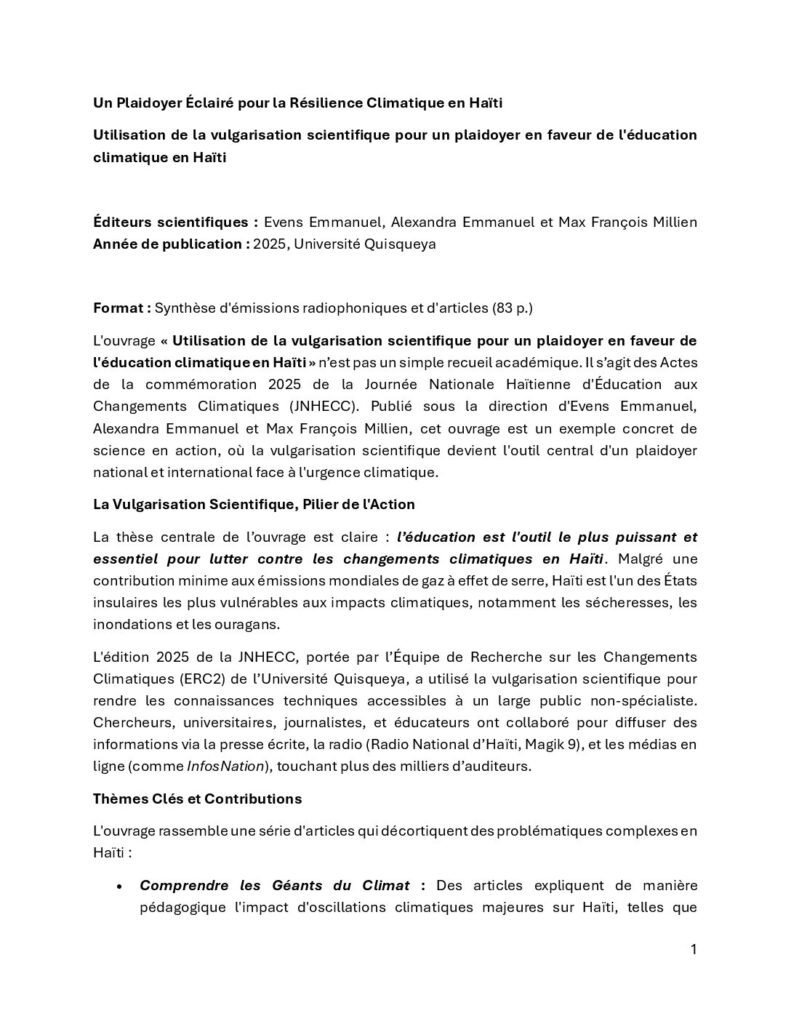
Use of scientific outreach for advocacy for climate education in Haiti
Scientific Editors: Evens Emmanuel, Alexandra Emmanuel and Max François Millien
Year of publication :2025, Quisqueya University Format: Synthesis of radio broadcasts and articles (83 p.)
The book « Use of scientific outreach for advocacy for climate education in Haiti « is not just an academic collection. These are the Acts of the 2025 commemoration of the Haitian National Day of Climate Change Education (JNHECC). Published under the direction of Evens Emmanuel, Alexandra Emmanuel and Max François Millien, this book is a concrete example of science in action, where scientific outreach becomes the central tool for national and international advocacy against the climate emergency.
Scientific Vulgarization, Pillar of Action
The central thesis of the book is clear: Education is the most powerful and essential tool to combat climate change in Haiti.Despite a minimal contribution to global greenhouse gas emissions, Haiti is one of the island states most vulnerable to climate impacts, including droughts, floods and hurricanes. The 2025 edition of JNHECC, led by the Research Team on Climate Change (ERC2) at Quisqueya University, used scientific outreach to make technical knowledge accessible to a broad non-specialist audience. Researchers, academics, journalists, and educators collaborated to disseminate information through the print press, radio (Radio National d'Haïti, Magik 9), and online media (such as InfoNation), affecting more than thousands of listeners.
Key themes and contributions
The book brings together a series of articles that decorate complex issues in Haiti:
• Understanding Climate Giants : The impact of major climatic oscillations on Haiti, such as the Atlantic Multi-Decennial Oscillation (AMO) and El Niño – Southern Oscillation (ENSO), has been taught. Understanding these cycles makes it possible to anticipate impacts (extreme droughts or rains) and adapt agricultural practices.
• Threat to Agriculture and Ecology :The work highlights farmers' vulnerability to climate extremes and the urgency of ecosystem restoration. The article on the National Park The Visit describes him as « ecological lung » and a vital water reservoir, the destruction of which amplifies the climatic effects.
• Climate History and Predictions: The article on Lake Azuei reveals that the study of its sediments allows to reconstruct 1000 years of Haitian climate. These paleoclimatic data are fundamental to informing future adaptation strategies.
• Public Health and Climate:The contributions stress the link between extreme rain/high temperatures and the rise of vector diseases (dengue, malaria). The call is launched for the integration of climate education into health programmes.
The Advocacy: Institutionalize September 1st
The ultimate objective of this publication is to draw the attention of the Haitian state authorities to the Turgeau Declaration of 2023, which established the 1 September as the Haitian National Day of Climate Change Education. Publishers and contributors *urge the Haitian State to formalize this date.* The institutionalization of this day is presented as a « National survival imperative » which would:
1. Strengthening Resilience:Le 1er septembre, veille de la rentrée scolaire, est une date stratégique pour mobiliser les jeunes, intégrer l’écologie dans les programmes éducatifs, et lancer des campagnes de sensibilisation et d’action citoyenne.
2. Affirmer la Diplomatie Scientifique :L’officialisation permettrait à Haïti de transformer sa vulnérabilité en un actif stratégique mondial. Elle renforcerait la visibilité des efforts haïtiens auprès des instances internationales comme la CCNUCC et l’UNICEF , et attirerait les financements durables nécessaires à la lutte climatique. En conclusion, cet ouvrage marque un tournant. Il est la preuve que, en Haïti, la communauté scientifique et la société civile unissent leurs forces pour faire de l’éducation un rempart face aux changements climatiques.
Il ne s’agit plus de subir, mais d’ « Éduquer pour Survivre, Innover pour Triompher « .L’appel est lancé à l’État pour qu’il s’approprie cette initiative citoyenne et la transforme en une politique publique durable.
emmanuel-et-al.-2025.-utilisation-de-la-vulgarisation-scientifique-pour-un-plaidoyer-1.pdf
Quetya AUBIN
Haiti-Antilles Pole, Haiti Science and Society (Ha-Sci-So)
Team of Scientific Partners for Research Communication (E-PSi-CoRe)