©️photo : Info Benin Portal
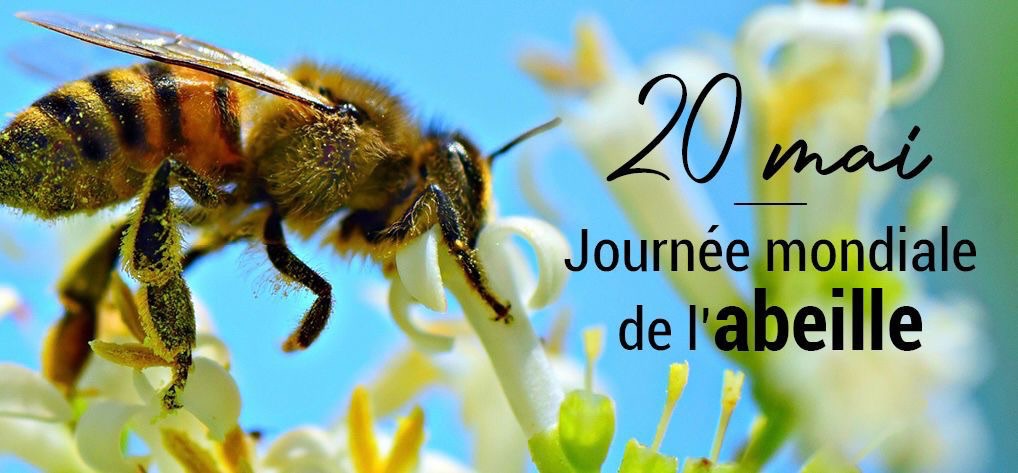
Petion-ville, May 20, 2026.- They do not make any noise in political debates, do not appear in official speeches, and yet, without them, the mangoes of the Great Anse would be less generous, the peas less abundant, and the plates of millions of Haitians even more empty. Bees work in silence, and this may be why they are so easily forgotten. On this World Bee Day, May 20, a look at what these insects do and what we owe them.
One third of world food production depends on bee pollinating activity, according to FAO (Food and Agriculture Organization of the United Nations) and UNEP (United Nations Environment Programme). Globally, 75% of food crops and 35% of agricultural land are based on pollination, which also provides nearly 90% of the reproduction of wild flowering plants, informed IPBES (Intergovernmental Platform on Biodiversity and Ecosystem Services) in 2016. In Haiti, where more than half of the population depends on agriculture, this reality takes on a special relief: on the mornes of the South or in the orchards of the Great Anse, mangoes, avocados, citrus fruits and peas owe much of their fertility to these insects with transparent wings.
In the municipality of Bonbon, the district of Jérémie, beekeeping proved that it could transform an existence. Ilarion Célestin, a local beekeeper supported as part of a project to combat desertification led by FAO and the Haitian Ministry of the Environment, went from a production of about two gallons of honey a year to nearly 270 gallons. With this income, he sent his children to school, built his house and bought cattle. Currently, a gallon sells about 9,000 gourdes in Port-au-Prince.
This success is not the result of chance. FAO, with the financial support of the European Union, provided 600 modern hives to 60 beekeepers grouped into two organisations in the communes of Bonbon and Abricots, and transplanted nearly 15,000 honeybee seedlings over 30 hectares around the apiaries. The Organisation of Bonbon Beekeepers (OAB) and the Association of Beekeepers of Apricots (AAA) are now marketing their production under a common label, outlining the contours of a structured sector.
From hives to social networks, a channel that seeks its voice
Further north, in the municipality of Moron, also in Grand-Anse, the association APESE Haiti collaborates with the Gwoup Famm Tet Kolé Rosali to modernize beekeeping practices and offer an additional income to rural populations, particularly vulnerable since the passage of Hurricane Matthew in 2016. Apiculture is thought of as both as an economic lever and as a resilience tool for peasant women.
In Port-au-Prince, Nesly Paul, a journalist converted into a beekeeper, embodies another way of defending bees. Founder of Myèl Lakay/Miel Pur, he uses social networks to enhance Haitian honey and broaden the consumer circle. Its logic is simple: « Investing in this sector is investing in biodiversity, encouraging a green environment. » More consumers, more beekeepers, more bees and mechanically, better pollination.
These successes, however, face an alarming national reality. More than 85% of Haitian watersheds would be in a critical state or completely deforested, resulting in erosion of arable land with direct consequences for agriculture. Without trees, no flowers; No flowers, no bees. Deforestation causes fruit, forest and herbaceous species to disappear, while several endemic wildlife species – mammals, reptiles, birds – are now threatened or have already disappeared, according to the International Union for Conservation of Nature (IUCN). Climate change worsens the situation: during droughts, bees have to travel longer distances to find nectar and water, thereby reducing honey production.
On May 20, the discreet buzz of bees recalls a simple truth: protecting pollinators is protecting ecosystems and in Haiti, it is also protecting the crops, incomes and plates of millions of people. Train more beekeepers, supervise the use of pesticides, replant melliferous species: the tracks are known, the experiments exist, the results are there. They need to be given the place they deserve at the heart of national priorities.
Jacques Wheps CASTIL