A radical philosophical reflection on the Western Reference
LADIREP Seminar • 26 December 2026
By Shakespeare EMILE
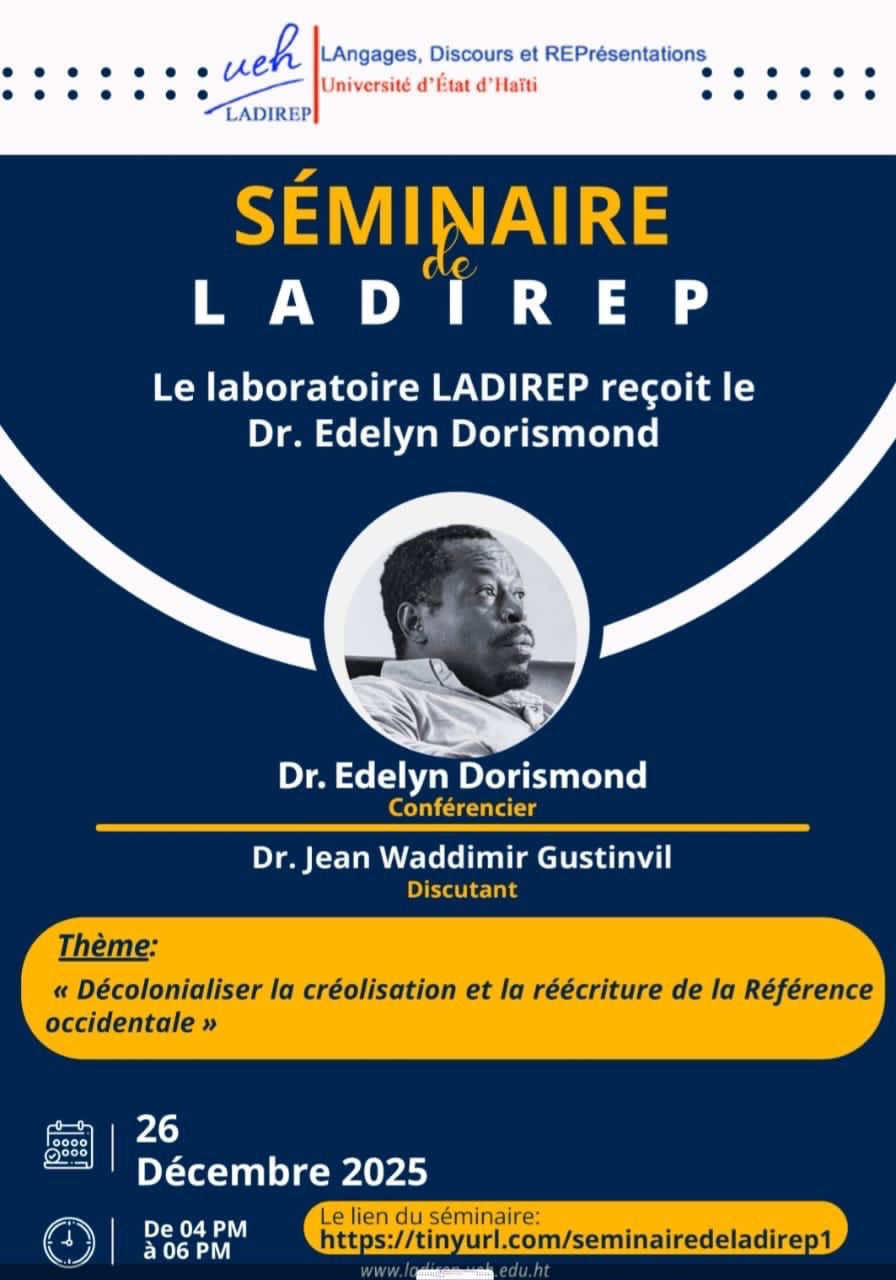
Le 26 décembre 2026, le Laboratoire de Langues, Discours et Représentations (LADIREP) accueillera le Dr EdelynDorismond pour une conférence qui promet de bousculer les fondements mêmes de la pensée décoloniale contemporaine. Sous le titre « Décolonialiser la créolisation et la réécriture de la ‘Référence’ occidentale « , ce philosophe haïtien propose une réflexion audacieuse qui interroge les limites de la pensée glissantienne et ouvre des perspectives inédites pour penser l’émancipation intellectuelle et politique des sociétés caribéennes.
The LADIREP: a laboratory at the heart of Caribbean dynamics
Since its creation, the Laboratory of Languages, Speeches and Representations (LADIREP) has established itself as a leading intellectual and scientific space for the analysis and understanding of the profound transformations that go through Haiti and the Caribbean. LADIREP is multi-disciplinary, both in terms of its objectives and its vocation and its approach to the construction of its study object. It brings together researchers from social anthropology, philosophy, history, linguistics and psychosociology, all driven by the same ambition: to grasp the complexity of the processes of social construction at work in a changing region.
One of the strengths of the LADIREP laboratory is its ability to articulate different analytical scales. These main researches concern as well as phenomena of Haitian national reality as on mobility, exchanges and flows of ideas, goods and individuals on a Caribbean scale. This multiscalar approach allows us not to lock Haiti in an island reading, but to think of it as a node in a regional network of cultural productions and social processes.
A tradition of scientific excellence
Evaluated in January 2015 by a commission of international experts, LADIREP obtained the authorisation of the Doctoral College of Haiti to host doctoral students. This institutional recognition reflects the scientific rigour that characterizes the work carried out within the laboratory. The LADIREP does not just produce knowledge, it establishes within it the principle of peer evaluation while providing a training space for the new generation of Haitian and Caribbean researchers, thus ensuring the transmission and renewal of questions, teaching-learning of scientific methods/methodologies.
Research seminars: a space for intellectual and scientific debate
At the heart of the scientific life of LADIREP are the organization of conferences, study days, seminars and research seminars, real spaces for exchange, intellectual confrontation and interdisciplinary dialogue between junior and senior researchers. These regular meetings allow us to invite renowned researchers like emerging researchers to present their work in progress and to submit them to the reactions and criticisms of their peers. It is in this tradition of excellence that Dr. Edelyn Dorismond's intervention, whose bold thinking promises to fuel fruitful debates on contemporary issues of intellectual decolonization, takes place.
Dr. Edelyn Dorismond: portrait of a committed philosopher
Edelyn Dorismond embodies a singular intellectual figure in the Haitian and Caribbean philosophical landscape. Doctor of Philosophy, Co-Director of Research Dominican Republic, Vice-President of CRENEL (Centre de Recherches Norms, Interchanges et Langage), member of the LADIREP and attached to the LLCP of the Department of Philosophy of the University of Paris 8, his journey bears witness to a deep anchor in international academic networks, while remaining firmly rooted in Haitian and Caribbean issues.
A demanding intellectual and scientific journey
From 2016 to 2022, Edelyn Dorismond held the position of programme director at the International College of Philosophy (CIPh), a prestigious institution founded at the initiative of Jacques Derrida, which aims to promote innovative philosophical research beyond traditional academic frameworks. This Parisian experience has undoubtedly fed his reflection on the modes of circulation and legitimization of philosophical knowledge at the international level.
Currently teaching at the State University of Haiti (Campus Henry Christophe), Dorismond embodies this intellectual come-and-go between European academic centers and Caribbean spaces of knowledge production. His doctoral thesis, devoted to a conceptual grasp of modern slavery in the Caribbean according to the requirements of philosophy, bears witness to his ambition: to think of the Caribbean experience not as a mere object of anthropological or historical study, but as a philosophical place in its own right, capable of producing new concepts and questioning the categories inherited from Western tradition.
Innovative research axes
Edelyn Dorismond's work revolves around several major axes that feed each other:
- The dynamics of Caribbean societies : how to understand the social, political and cultural transformations that work in contemporary Caribbean societies?
- Experience of diversity What new problems do the social sciences face in the political and social experience of diversity in post-slavery contexts marked by the forced encounter of populations of multiple origins?
- The memory conflict : how do you think the coexistence, sometimes conflictual, of different memories linked to the encounter of cultural agents in the Caribbean space?
- The political philosophy of minorities How can we reformulate the question of political philosophy in the light of the demands of minority groups?
An already substantial work
Edelyn Dorismond's intellectual production reflects a reflection that is both systematic and rooted in contemporary debates. His major publications include:
The age of mixedness. Variations on Creolization: Politics, Ethics and Philosophy of Diversity (Paris, Anibwé, 2013), where he developed the concept of « diversity » to think about the political and ethical forms of creolization.
The Haitian Problem. Test on the coloniality of the Haitian state (Port-au-Prince, Éditions Étoile Polaire, 2020), a critical analysis of colonial structures that continue to structure the postcolonial Haitian state.
Memory and history. The postcolonial Haitian experience. Tribute to Michel-Rolph Trouillot_ (Press of the State University of Haiti, 2020), which is part of the wake of Haitian anthropologist to think the complex relationship between collective memory and history writing.
To these works are added numerous articles in leading scientific journals on creolization, the philosophy of history, natural disasters and their existential dimension, or the circulation of French thought (Deleuze, Derrida) in the work of Édouard Glissant.
Decolonizing Creolization: an ambitious and radical philosophical proposal
La conférence qu’Edelyn Dorismond s’apprête à prononcer au LADIREP constitue un moment important dans l’évolution de la pensée décoloniale caribéenne. Son titre même, « Décolonialiser la créolisation et la réécriture de la ‘Référence’ occidentale « , indique l’ampleur du projet : il ne s’agit pas seulement de critiquer la domination coloniale, mais de soumettre à l’examen critique les outils conceptuels que nous mobilisons pour penser l’émancipation.
The title trap: clarifying ambiguity
Dorismond commence par reconnaître que le titre de son intervention « prête à confusion « . En effet, formulé ainsi, il pourrait laisser croire que la décolonisation devrait concerner à la fois la créolisation et la réécriture de l’imaginaire occidental. Or, précise-t-il, « la décolonialisation porte précisément sur la créolisation « . Cette clarification est essentielle : ce n’est pas la créolisation qui est un outil de décolonisation, mais bien la créolisation elle-même qui doit être décolonialisée.
This bold proposal is based on one observation: the thought of creolization, as developed in particular by Édouard Glissant, despite his criticism of the metaphysics of the One and his celebration of diversity, remains trapped in certain structures of thought inherited from Western tradition. In other words, slippery creolization would not have gone far enough in its break with the West.
The Reference : key concept of Pierre Legendre
Pour comprendre l’argument de Dorismond, il faut d’abord saisir ce qu’il entend par « Référence « . Il emprunte ce concept au juriste et psychanalyste français Pierre Legendre, dont les travaux ont mis au jour un dispositif anthropologico-théologique et juridique au cœur de la civilisation occidentale. Selon Legendre, la Référence s’est imposée dans la tradition romano-chrétienne comme un mode spécifique de « gestion du désir par la loi « .
Cette gestion repose sur un montage symbolique fondamental : l’invention du « père » comme instance tierce, incarnée dans la figure du Pape. Le Pape, en tant que « père des pères « , représente l’Autorité ultime qui garantit la loi, légitime le pouvoir et structure l’ordre social. Cette figure paternelle n’est pas simplement une métaphore : elle constitue le pivot d’un système de légitimation qui traverse toute la culture juridique et politique occidentale.
« La Référence tient son montage de l’invention du ‘père’ (le pape). Dans la pensée de Glissant, malgré les critiques de la métaphysique de l’un, la loi dans sa fonction de gouvernement du désir reste inchangée. «
The limit of Sliding: Silence over God
C’est ici que Dorismond identifie une lacune majeure dans la pensée glissantienne. Glissant a brillamment déconstruit la métaphysique de l’ « Un « , célébré le multiple, théorisé la « poétique de la Relation » et l’« éclatement du désir dans les champs de la rencontre « . Pourtant, souligne Dorismond, « la loi dans sa fonction de gouvernement du désir, reste inchangée « . En conséquence, elle continue de « tenir son assurance de la présence du père ou de l’un « .
Le diagnostic est sévère : « Tout se passe, en dépit de la diversalité, sous le regard impassible du Dieu chrétien. » Glissant n’a jamais vraiment interrogé la question de Dieu et de sa relation à la diversité. Il constate que les sociétés créoles sont « à origines plurielles « , mais il ne questionne pas ce qui « tient ensemble un ‘ordre’ créole « . Autrement dit, Glissant aurait fait l’économie d’une réflexion sur le fondement symbolique de l’ordre social dans les sociétés créoles.
The project: Rewrite the Reference
Face à cette limite, Dorismond propose un geste philosophique radical : « réécrire la Référence « . Il ne s’agit pas simplement de la critiquer ou de la rejeter, mais de la reconfigurer en profondeur. Cette réécriture implique de « la défaire de la figure du père-pape, garant de la loi, du pouvoir et instance de domination « .
But how do we proceed? Dorismond's proposal is bold: « make it burst into a kind of polytheism, understood as lack of reference, paternity strategy and not absence or presence of the father. » It is therefore not a question of simply denying the paternal function or the need for a third body regulating desire. Rather, it is a matter of moving from a monotheistic logic, centred on a single and transcendent Father, to a polytheistic logic, characterized by a multiplicity of references and legitimization strategies.
« Réécrire la Référence, la défaire de la figure du père-pape pour la faire éclater dans une sorte de polythéisme, compris comme absence de référence, stratégie de paternité et non absence ou présence du père. «
Creole countermetaphysics
If this rewriting is carried out, says Dorismond, « Creolization becomes a veritable counter-metaphysics of unity, power, domination and a pragmatic of existence that is built by ‘many ways and opportunities'. » This wording deserves to be deployed:
- Countermetaphysics of unity : Creolization thus redesigned does not simply celebrate diversity as an empirical fact, but it is a metaphysical alternative to Western tradition which, since Parmenide, favours One over Multiple.
- Countermetaphysics of power By decentralizing the figure of the Father as the sole source of authority, this creolization opens the possibility of less vertical, less concentrated, more distributed forms of power.
- Counter-metaphysics of domination : polytheistic logic implies the absence of an instance of absolute domination, which better corresponds to the forms of social organization observable in Creole societies.
- Pragmatic of existence : plutôt qu’une essence fixe ou un destin prédéterminé, l’existence créole se construit de manière contingente, par « manières et occasions « , au gré des rencontres et des circonstances.
From decolonization to decolonization
Dorismond propose également une distinction conceptuelle importante entre « décolonisation » et « décolonialisation « . La décolonisation, au sens classique, désigne le processus politique et juridique par lequel les colonies ont accédé à l’indépendance formelle au XXe siècle. La décolonialisation, en revanche, désigne un processus plus profond et plus long : celui qui vise à défaire les structures symboliques et épistémiques de la domination coloniale.
As Dorismond writes, decolonisation « is an approach that takes more responsibility for the symbolic forms of slave dominations and their modes of symbolization at work in creolization. » It is therefore not enough to achieve political independence; We must transform in depth the imaginations, the structures of thought and the modes of legitimation that continue to reproduce relations of domination inherited from slavery and colonization.
Policy and existential issues
Dorismond's proposal is not just an academic exercise. It carries considerable existential and political challenges for Caribbean societies. Indeed, if Creolization remains a prisoner of the Western theological-political structure (the Father-Pap as guarantor of order), then Creole societies will remain unable to truly think themselves and build truly alternative political forms.
Conversely, a truly decolonized creolization based on a polytheistic logic of the Reference would open the possibility of forms of social organization, of regulating desire and of legitimizing power that would be endogenous to Caribbean societies, rather than imported from the Western matrix.
« La créolisation devient une véritable contre-métaphysique de l’unité, du pouvoir, de la domination et une pragmatique de l’existence qui se construit par ‘manières et occasions’. «
A long thought
The conference of Edelyn Dorismond promises to be a strong intellectual moment in the life of LADIREP and, beyond that, in contemporary debates on the decolonization of thought. By proposing to subject Creolisation itself to decolonial criticism, Dorismond made a philosophical gesture of great audacity: he refused the ease that would be to celebrate creolization without nuance as a miracle solution to the problems posed by the colonial heritage.
His proposal – rewriting the Reference by breaking it in a polytheistic logic – is an ambitious research programme that engages both political philosophy and anthropology, psychoanalysis and the history of religions. It calls for a profound rethinking of the symbolic foundations of social order in Creole societies and, more broadly, in all societies derived from colonial experience.
Beyond conceptual rigour and philosophical scholarship, what strikes in Dorismond's approach is his existential and political reach. It is not a question of producing an abstract theory, but of contributing to the intellectual and practical emancipation of Caribbean societies. It is this articulation between the theoretical requirement and political commitment that makes this emerging thought very interesting.
The discussions following this conference will undoubtedly clarify certain aspects of this proposal, test its argumentative strength and explore its implications. One thing is certain: by daring to ask the question of the decolonisation of Creolization, EdelynDorismond opens a major intellectual site for the Caribbean thought of the 21st century.
PRACTICAL INFORMATION ON THE CONFERENCE
Date : 26 December 2026
Location : LADIREP (Languages, Speeches and Representations Laboratory)
Link : https://tinyurl.com/seminardeladirep1
Link to the seminar:
https://teams.microsoft.com/dl/launcher/launcher.html?url=%2F_%23%2Fl%2Fmeetup-join%2F19%3AG1tO6vssAyD2zDfGwv4sZTTf1aVzPt3AbyX37WlYxVY1%40thread. tacv2%2F1738761460754%3Fcontext%3D%257b%2522Tid%2522%253a%2522687b1e1-4264-4f8d-8528-d5e3f4e6a8a6%2522%252c%2
Speaker : Dr. Edelyn DORISMOND
Theme : « Décolonialiser la créolisation et la réécriture de la ‘Référence’ occidentale «
Public : Researchers, PhD students, teachers and students in the social sciences and humanities
Keywords : Creolization• Decolonization• Decolonization• Desire • Law • Paternity • Reference • Slide • Legend • Caribbean philosophy
References
Works by Edelyn Dorismond
Dorismond, E. (2013). The age of mixedness. Variations on creolization: politics, ethics and philosophy of diversity. Paris: Anibwé.
Dorismond, E. (2020). The Haitian Problem. An essay on the coloniality of the Haitian state. Port-au-Prince : Editions Étoile Polaire.
Dorismond, E. (2020). Memory and history. The postcolonial Haitian experience. Tribute to Michel-Rolph Trouillot.Port-au-Prince: Presses of the State University of Haiti.
Articles and chapters of Edelyn Dorismond
Dorismond, E. (2009). La créolisation de la politique, la politique de la créolisation : penser un « im-pensé » dans l’œuvre d’Édouard Glissant. Revue Sens Public, n° 11/12, « Malaise dans le capitalisme « .
Dorismond, E. (2010). Le Créole haïtien dans le devenir monde de la « mondialisation « . Revue Études Créoles, « À propos d’Haïti « . Paris : L’Harmattan.
Dorismond E. (2012). Exist in disasters. Pain and identity. In J.-D. Rainhorn (ed.), Haiti. Reinvent the future (pp. [n.p.]). Paris: House of Human Sciences and Presses of the State University of Haiti.
Dorismond, E. (2013a). Les figures de la diversité antillaise. Esquisse d’une « philosophie politique » de la « diversalité « . In G. Navet & S. Villavicencio (dir.), Les figures de l’hétérogénéité et diversité culturelle (pp. [n.p.]). Paris : L’Harmattan.
Dorismond, E. (2013b). Is Creolization a philosophy of history? Colonial history of the West Indies, globalization and globalization. The Rings of Memory.
Dorismond E. (2014). Earth phenomenology and philosophical anthropology of the consequences of the earthquake. In L. Hurbon (ed.), Disasters and environment. Haiti, earthquake of 12 January 2010 (pp. [n.p.]). Paris: EHESS.
Dorismond, E. (2020c). Creolization and community. Various and political republic of the meeting. In F. Noudelmann, F. Simasotchi-Bonès & Y. Thomas (dir.), Archipelos Glissant (pp. [n.p.]). Vincennes : University Presses of Vincennes.
Dorismond, E. (2020d). The philosophy of history tested by Caribbean societies. In Philosopher in the Caribbean, Journal Cahiers critiques de philosophie, n° 20.
Dorismond, E. ([n.d.]). How Deleuze and Derrida travel in the slippery thought of creolization. Revue Rue Descartes, n° 78, pp. 34-47.
Conceptual references
Slipper, E. (1990). Poetic Relation. Paris: Gallimard.
Slipper, E. (1996). Introduction to a Poétique du Divers.Paris: Gallimard.
Slipper, E. (2009). Philosophy of Relationship. Poetry in range. Paris: Gallimard.
Legendre, P. (1974). Love of the censor. Dogmatic order test. Paris: Éditions du Seuil.
Legendre, P. (1985). Inestimable object of transmission. Study on the genealogical principle in the West. Paris: Fayard.
Legendre, P. (2001). From the Society as Text. Lineaments of dogmatic anthropology. Paris: Fayard.
Trouillot, M.-R. (1995). Silencing the Past: Power and the Production of History. Boston: Beacon Press.
Online resources
International College of Philosophy (CIPh). Official site: www.ciph.org
Sens Public magazine. Free access: www.sens-public.org
All-World Institute – Édouard Glissant Research Centre. www.any-world.com
Article published in Espace Sciences et Société, InfosNation
Shakespeare Emile
Student in Master of Philosophy and Transculturality
ENS/ Université Paris 8
shakesemile@gmail.com