©️The Presidency
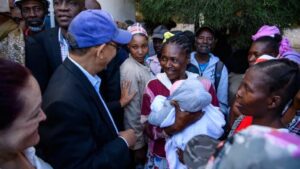
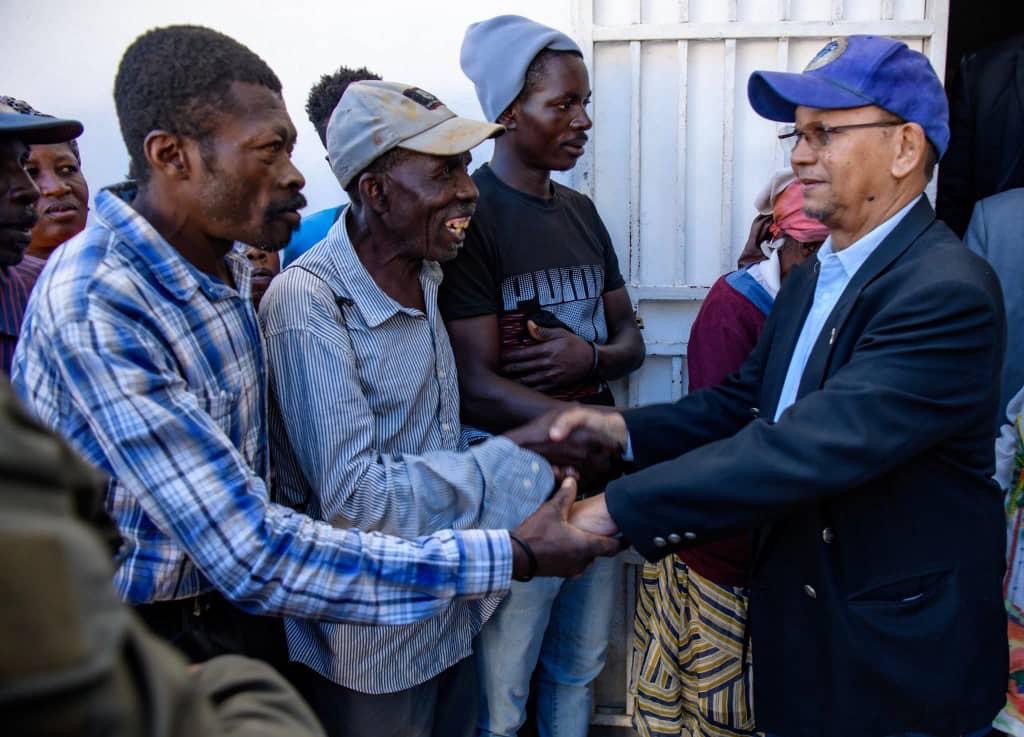
Kenscoff, 3 November 2025.- On a visit to Kenscoff, this Monday, 3 November, Councillor-President Leslie Voltaire, accompanied by Ambassador of Colombia Vilma Rocio Velázquez Uribe, and General Director of the Fund for Economic and Social Assistance (FAES), Serge Gabriel Colin, participated in a distribution of food kits for internally displaced persons. This action is part of the strengthening of cooperation between Haiti and Colombia, as the country continues to suffer from insecurity and the damage caused by Hurricane Melissa.
Councillor-President Leslie Voltaire led, this Monday, a delegation to Kenscoff to demonstrate the Haitian government's solidarity with families displaced for nearly nine months because of insecurity. Together with the Ambassador of Colombia and the Director General of FAES, he welcomed Colombia's commitment to humanitarian aid to Haiti. According to Mr. Voltaire, this fruitful cooperation, reinforced since President Gustavo Petro's visit to Jacmel at the beginning of the year, is also manifested in the areas of trade, security and training, with already 52 young Haitians in vocational training in Colombia.
Local authorities, including the Mayor of Kenscoff, Massillon Jean, expressed their gratitude for this initiative. After the distribution, the delegation visited the Office of the Commissioner, the site of the future modern market and the National High School of the municipality. The Councillor-President reaffirmed the commitment of the Transitional Presidential Council (CPT) to combat insecurity and promote the progressive return of internally displaced persons to their homes.
However, this solidarity visit comes in a climate of tension. A week earlier, on Monday, 27 October, during his visit to the camp for displaced persons from Colombia in Bourdon, Leslie Voltaire had been greeted by hostile hues and slogans. The residents had denounced the slow pace of the Government's response and recalled that ad hoc food aid could not replace lasting solutions to the humanitarian crisis that burdened them.
At the same time, the Haitian government declared the state of emergency for three months, from 3 November 2025 to 3 February 2026, in six departments (South, South-East, Grand Anse, Nippes, West and North-West) struck by Hurricane Melissa. This measure aims to accelerate assistance to the affected and reconstruction of the affected areas, in a context where the precariousness and vulnerability of the population remain at the heart of national priorities.
W.A.