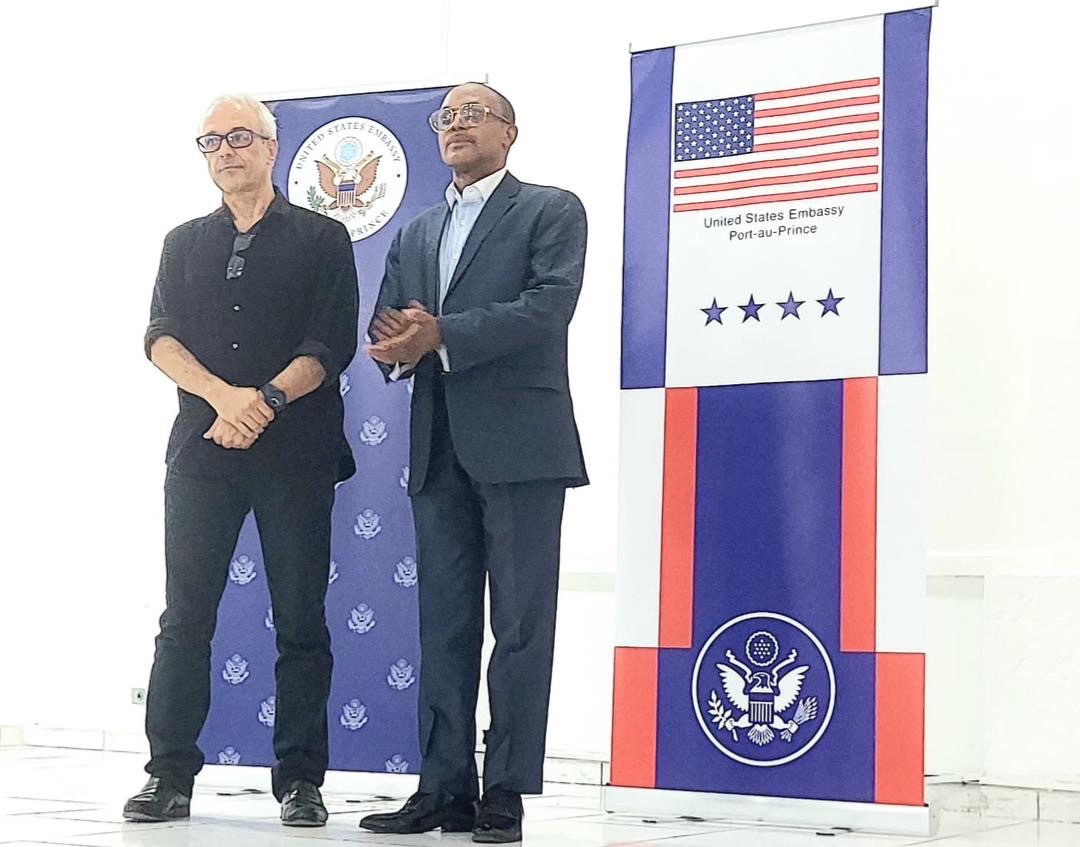
Engineer Patrick Attie (left) and journalist Dr Joël Lorquet (right)•©️photo : R. J.
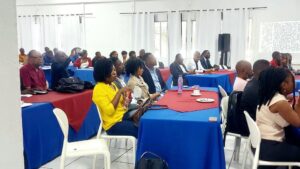
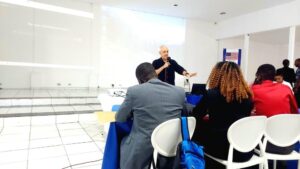
Port-au-Prince, March 5, 2026.- From Monday 2 to Wednesday 4 March 2026, some 60 journalists participated in a training seminar on artificial intelligence (AI) and its integration into journalistic practice. This activity was organized on the initiative of the Office of Public Affairs of the Embassy of the United States in Haiti and implemented with the support of the Higher School of Computer Science of Haiti (ESIH), responsible for supervising the participants. It took place around the theme: « The increased journalist: integrating artificial generative intelligences without compromising editorial independence « . For three days, media professionals exchanged with experts on the opportunities and limitations of these tools, in a context where technological transformations profoundly redefine the production of information.
Journalist Joël Lorquet opened the work by recalling that journalism is now evolving in a digital environment marked by the instantaneousity of the dissemination of information. According to him, technology allows almost everyone to publish content, but « publishing does not mean informing « He explained that the AIA can be an asset for journalists, but it has certain limitations: « artificial intelligence can save us time, but it will never replace responsibility and human emotion in the processing of information « .
For its part, Amparo Garcia, press officer at the United States Embassy in Port-au-Prince, stressed the importance of strengthening journalists' skills in a world where technologies are changing rapidly. She recalled that AI is already integrated into several sectors, including the media. According to her, the training initiatives supported by the Embassy are aimed at promoting transparency, public accountability, democracy and freedom of the press.
The Director General of ESIH, Patrick Attie, a specialist in information technology, explained that generative artificial intelligence can perform up to 80-90% of the preparatory work in certain editorial tasks. However, the most critical steps remain human: fact-checking, contextual analysis and critical thinking. He also cautioned against algorithmic biases, recalling that the d
Asked by InfoNation, Joël Lorquet said that the idea for this seminar was born out of a regular online training programme for journalists.
The interest generated by discussions on artificial intelligence led several participants to propose the organisation of a face-to-face session. Some 60 journalists were among the first to register. He also indicated that many professionals in the regions wanted to participate, but that difficulties in moving to Port-au-Prince had limited their presence. The organizers therefore plan to replicate this training in other cities, particularly in Cap-Haitien.
La journaliste senior, Marie Lucie Bonhomme, également participante au séminaire, a salué une initiative qu’elle juge essentielle pour la profession. Elle explique que sa connaissance de l’intelligence artificielle était auparavant très limitée, mais que ces trois jours de formation lui ont permis de mieux comprendre les possibilités offertes par ces outils dans le travail journalistique. Elle a également abordé la question de la place des femmes dans la révolution numérique. Selon Marie Lucie Bonhomme, celles-ci ne doivent pas rester en marge des nouvelles technologies, mais se les approprier au même titre que les hommes. Elle a été claire sur ce point : « Personne ne donnera leur place aux femmes, ce sont elles qui doivent la prendre en se formant et en produisant un travail de qualité. » Pour la journaliste, c’est avant tout par la compétence et l’engagement que les femmes pourront s’imposer et obtenir la reconnaissance qu’elles méritent dans le milieu professionnel.
Au terme de ce séminaire, un constat s’impose pour les participants : l’intelligence artificielle constitue désormais un outil incontournable dans l’évolution du journalisme. Toutefois, les intervenants ont insisté sur le fait que la crédibilité de l’information repose toujours sur le professionnalisme, l’éthique et la capacité critique des journalistes. Dans un contexte marqué par la désinformation et les transformations rapides du secteur médiatique, la formation continue apparaît ainsi comme un levier essentiel pour renforcer une presse haïtienne plus moderne et plus responsable.
R.J.